It's a momentous day for me here, as I think a 13-year quest is finally at an end, and soon I won't be waiting for the kettle to boil every morning, or turning it on with a finger like a pleb. But this has been a long, long quest, so please indulge me for part 1, where I reflect for a moment on my journey to get here.
Kettle automation has been on my mind since at least 2013, when I was wiring my new apartment for automation with 1-wire buses and sensors, and just starting to get into wireless home automation in a big way. The goal was simple: when I wake up in the morning, by the time I reach the kitchen, the kettle should be boiled ready for me to make coffee, so I don't have to wait a couple of minutes for it to boil.
The desired principle of operation was equally simple. Some basic rules can infer when I want the kettle boiled automatically. First, I will have been in the bedroom for at least 5 hours. Second, I will leave the bedroom and enter the bathroom. A time of day filter can infer whether I have woken up or just got up in the night. These days, that rule would be even simpler, since I always set the alarm in the downstairs zone (but not the route to the bathroom), and I always start the day saying "OK Nabu, good morning!", so I can plug into that automation.
For other uses, when I want boiling water during the day, I can press a button before going to the kitchen so it's already starting to boil while I'm on my way.
This doesn't seem like it should be difficult, right? It's basically turning on power to a thing from a remote location, and we've been able to do that for a very long time in other areas of electronics.
Is it worth it?
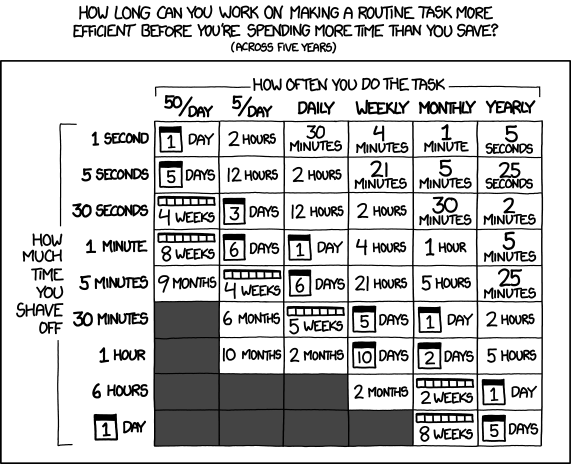
By having the kettle boiled by the time I reach it, I can shave 2 minutes off the start of my day (and get my caffeine faster). The amount of time invested to devise a solution should ideally pay back within a reasonable amount of time. If I average 1.2 cups of coffee a day and it takes 2 minutes to boil each time, then over a year I have spent nearly 15 hours waiting for the kettle to boil. Over 5 years I'll have waited 73 hours.
XKCD 1205 relates, although its definition of a day is working 24 hours straight, so it's a little confusingly put:
First iteration: switch control
Nobody made smart kettles back in 2013. Despite having been around for years, Zigbee and Z-wave were only just beginning to build a sufficient portfolio of products to start getting popular, and WiFi chipsets were too expensive to be putting in consumer products - Espressif and later Tuya (spit) would start to change this over the following decade.
Instead, I used the simplest possible solution. I bought a kettle with a mechanical clunk switch that, importantly, would stay latched on when the mains power was off. That is to say, the switch would only click back upwards once it reached boil or you removed it from the stand, not just because the input power was gone. Then I used a device to electronically switch the input power on remotely, initially with a manual button, later with automation according to the method described.
I toyed with making my own relay and putting it on my 1-wire bus, but I hadn't wired any of my buses to a suitable place and didn't want to drill into the shiny new kitchen countertop. Instead I decided to look at Zigbee and Z-wave, both low-power wireless mesh solutions. In Zigbee's favour was its openly-published standard, in Z-wave's favour was its certification process guaranteeing compatibility and its radio being outside the 2.4 GHz band (which was already getting crowded in a city centre apartment). I didn't know anything about the internals of either, but what I did know was that I wanted to eventually automate my heating, and there were several manufactures making radiator actuators for Z-wave but none at all for Zigbee, so I was sold on Z-wave.
In retrospect, I backed the wrong horse, and over the years fed the sunk cost fallacy by buying more and more Z-wave devices, eventually having a dimmer or relay on every light in the flat. Meanwhile, Zigbee dropped massively in price and overtook in terms of device types available, and eventually evolved into Matter (layer 7) and Thread (layer 3). And cheap Zigbee MCUs and dev boards became commonplace, while Z-wave's closed ecosystem precluded such things (except somehow the Z-Uno that cost a fortune and was, at least at the time, so undocumented that I never got around to using it).
So here's my first order for a Z-wave controller, a couple of dimmer modules, and a smart plug (relay module) for the kettle. An amazing £157 in 2013 money (£222 today), and that was special offer sale pricing!
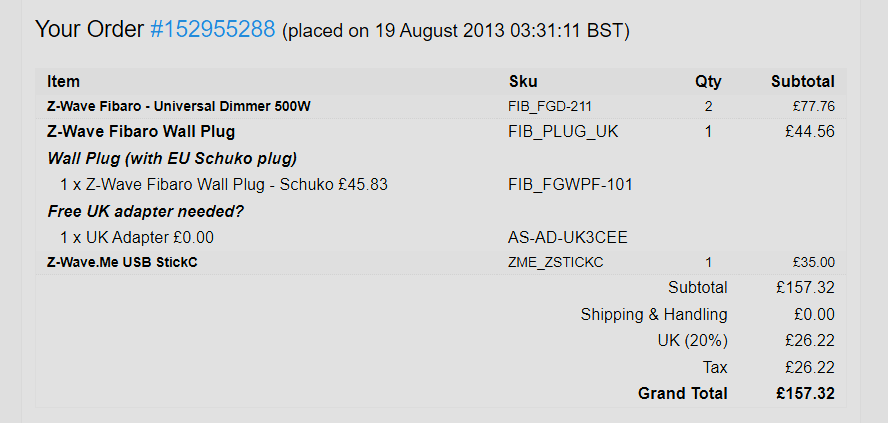
Staggeringly, these Z-wave parts cost significantly more today, not less. Meanwhile, you can get smart dimmable Zigbee bulbs from IKEA today for £5 and smart plugs for £6 - and IKEA's smart home range is actually quite good (their Zigbee range is currently gradually being replaced by Matter/Thread versions at the same or even lower cost, and first impressions are good).
With the smart plug installed on the kettle plug, the rest just became a software problem. As there was no Home Assistant or similar, it was all Python and C, it took me quite a while to integrate all my different HA protocols and move from just having a bedside "boil kettle" button to an actual automation, but I got there in the end.
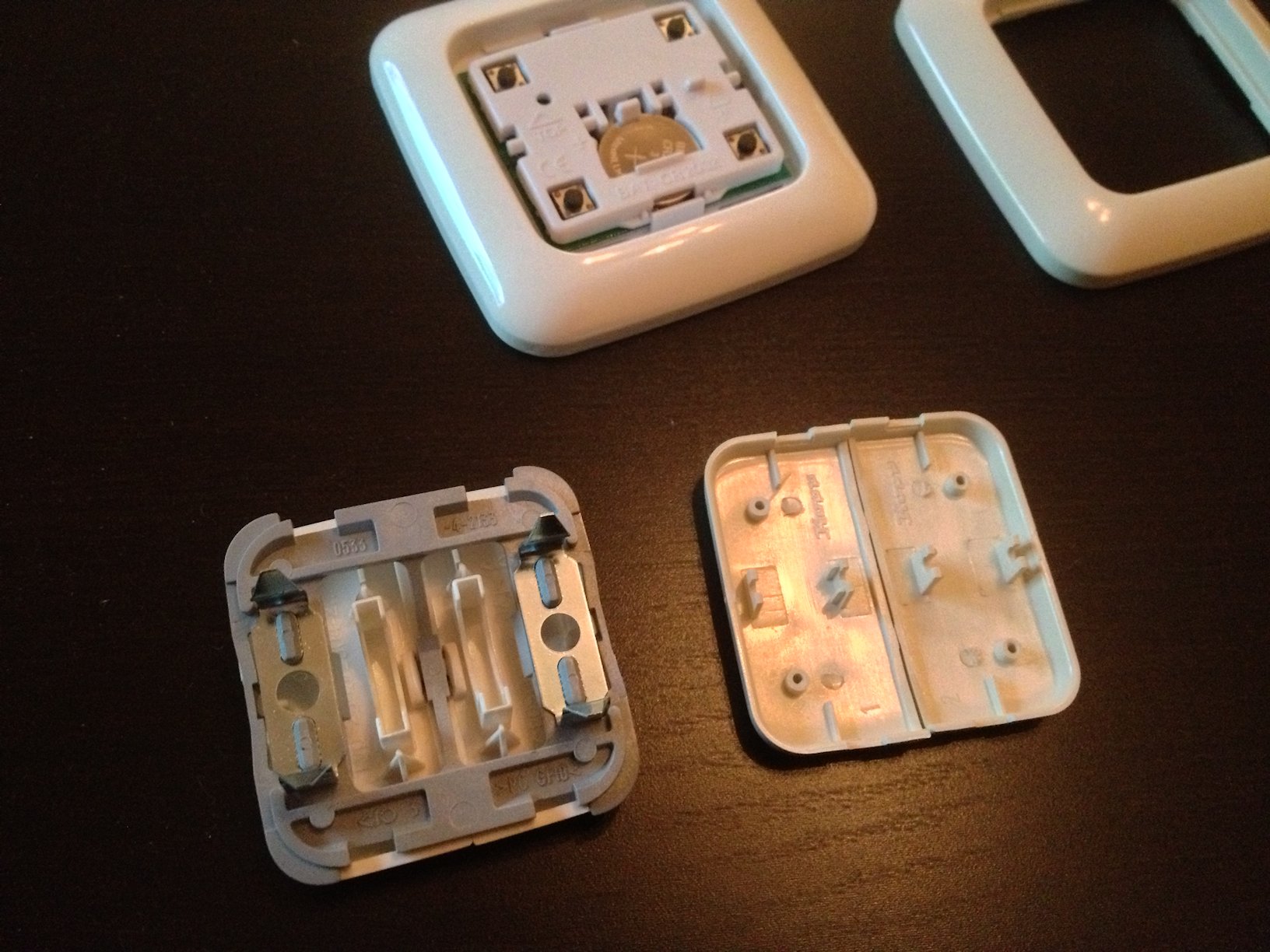
I don't have a photo of the setup, but it was basically a small plug inserted between the kettle's plug and the wall socket. This was the Z-wave four-button flush switch, which they had amusingly matched to the style of my Busch-Jaeger switches already in use, that I bluetacked to my bed's headboard:
But I was never really happy with this solution. It required me to do three things the night before: Fill the kettle, turn off the switch on the side of the Z-wave relay, and turn on the manual switch on the kettle, in that order. Miss any of those three things, and it failed to work. Do them in the wrong order, and the kettle switch wouldn't be latched down.
Second iteration: Electronic kettle
While I was quite pleased with myself for achieving the first iteration, I did want to be less reliant on remembering to set it up the night before, which was easily forgotten and I felt was rather counter to the automation concept, if I had to do work to set up the automation every time.
A couple of years after the Z-wave smart plug solution, we started getting kettles on the market with electronic buttons. These would often have several buttons to choose different temperatures, but the important thing was that the "boil" button was also electronic rather than electromechanical. The crucial factor was to get one with the buttons on the base (in a semi-fixed position) rather than on the kettle (highly mobile and with no space inside for adding additional components).
I thought this would allow me to easily tap into that button to signal the kettle to start boiling. Even if I couldn't figure out what signals or voltages to use, I could in the worst case wire a relay across the button and trigger it with full isolation.
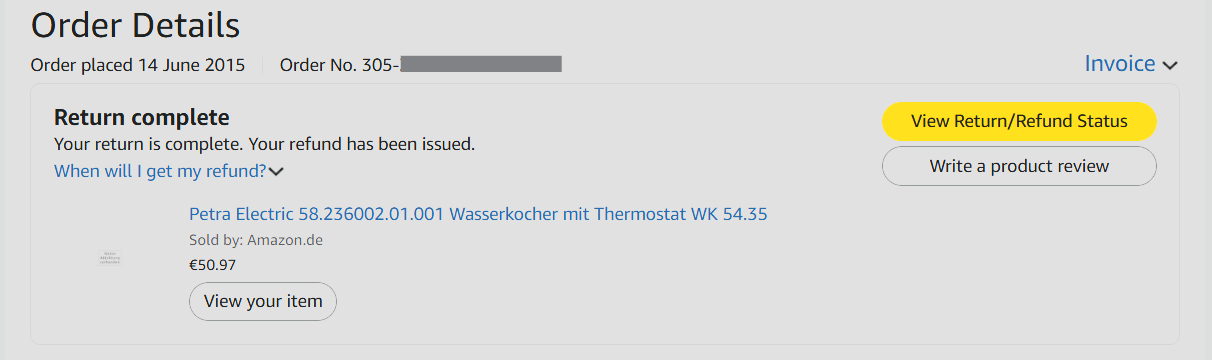
So I duly ordered myself an electronic kettle and broke it open. That's where this story ends though. While probing around inside the kettle with a multimeter, I managed to electrocute myself. 230V across my body was enough to make me immediately abort this project. I also entirely lost faith in RCDs as a method of protection because, to this day, I can still count the eight thundering pulses that ran through me before I separated myself. Eight pulses, at 50 Hz, is 160ms. Even if I was feeling both sides of the sine wave and it was just four periods, that's 80ms. An RCD is supposed to trigger in a maximum 40ms, and I can't explain why it didn't, because there was certainly more than 30mA for it to have hurt that bad.
I also can't fully explain what happened. I was very careful, before powering it up, to clearly identify the high voltage areas, and I was working only in the logic area. I do know that I touched the kettle body, which I later verified was connected to earth. I suspect that the low voltage power supply was for some reason referenced to one of the mains pins (which, since Schuko is not polarised, I had unluckily matched with the live pin), and I was touching the probe or something on the board with my other hand.
This experience was enough for me to abandon this line of experimentation and revert to my first manual automation method for years.
Interlude: Boiling water taps
By the early 2020s, my friends were starting to get instant boiling water taps. These work by storing very hot water in a tank under the sink, but pressurised so that it doesn't have to be stored at the full 100°C. When the tap is set to emit boiling water, the change in pressure brings it back up to temperature. This has the immense advantage of boiling water always being available, not just when an automation has prepared it for me.
This diagram shows one with a separate boiling water tap. These days you can get ones where the boiling water is integrated into your main tap, and you activate boiling mode by double-pushing and twisting a knurled section of the tap body.
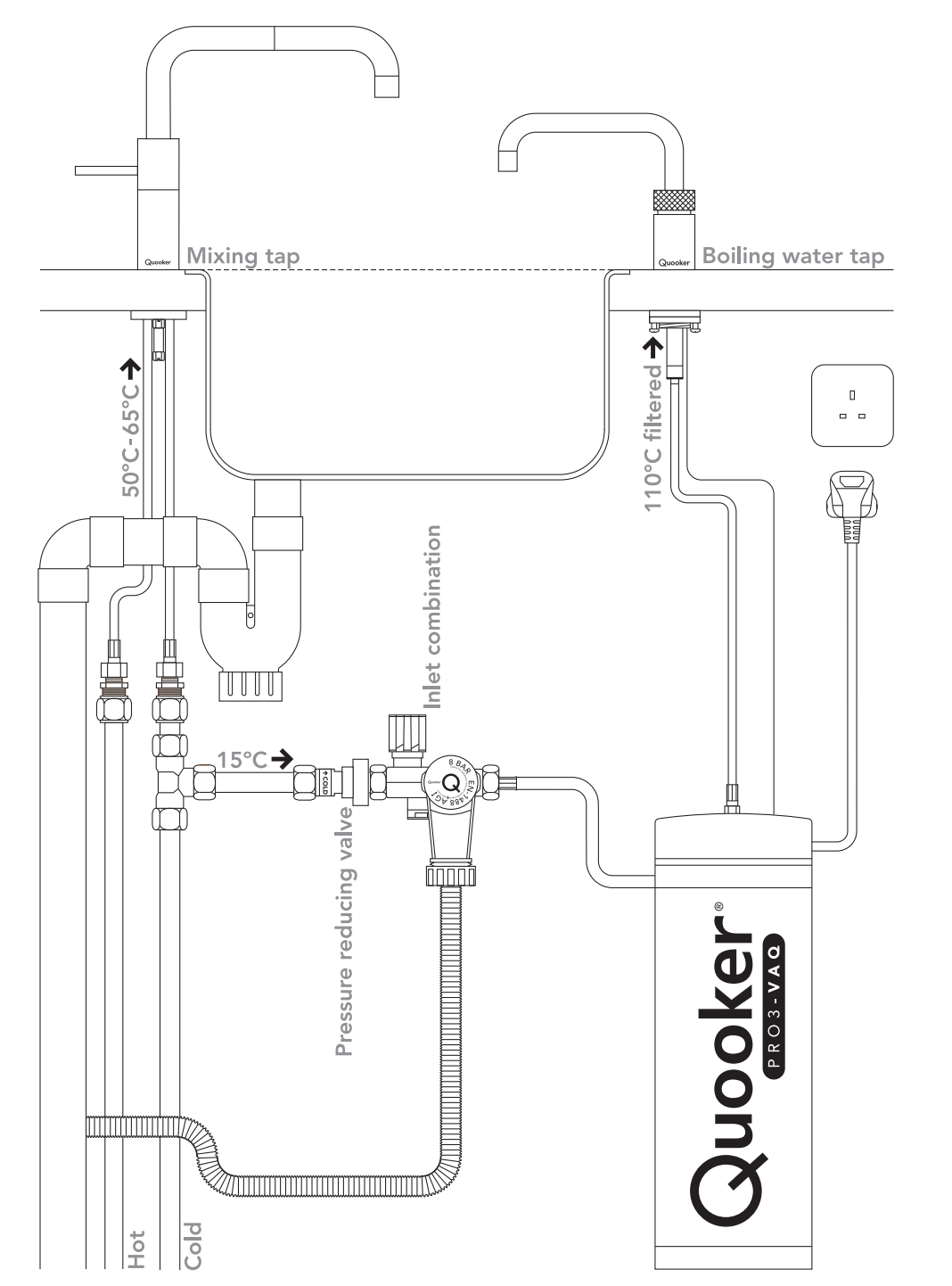
These do, however, still require the temperature to be maintained in the pressurised reservoir under the sink, so they require constant electrical heating. Intrigued by whether this would be the cop-out that would let me finally abandon the smart kettle dream, I asked a friend to put an inline meter on theirs to find out just how much electricity it consumed.
They monitored it for a couple of months, over which time it consumed an average of 25W. This gives 600 Wh per day, or 219 kWh per year. At an electricity price of £0.24 per kWh (my current tariff in March 2026), that's a running cost of £52.56 per year, or 14.4p per day. Not to mention a very high purchase and installation cost in the first place.
For me, those economics don't work out. I tend to drink one cup of coffee a day, and I've measured this using 0.073 kWh, or 1.75p, per boil, at the level I usually fill for 1 cup. There are some variables and margins of error here that mean it's not a great comparison, not least that there are twice as many adults in my friend's household, but the order-of-magnitude difference has led me to not install one for now. Maybe this will change in the future, if my boiling water requirements increase, or if they become more efficient. Someone even made a calculator that shows it pays off in 150 years for them, or for me, never pays off.
Why no smart?
In the meantime, in an era where low-cast ESP8266 and ESP32 modules opened the road to mass-market home automation, I started pondering why nobody was really selling smart kettles - the few that were available were either locked into a closed ecosystem with a proprietary protocol, or were extortionately expensive (£150+) due to lack of competition.
And then I found one. Read part 2 for the next stage of my journey.